Cathy Beesey
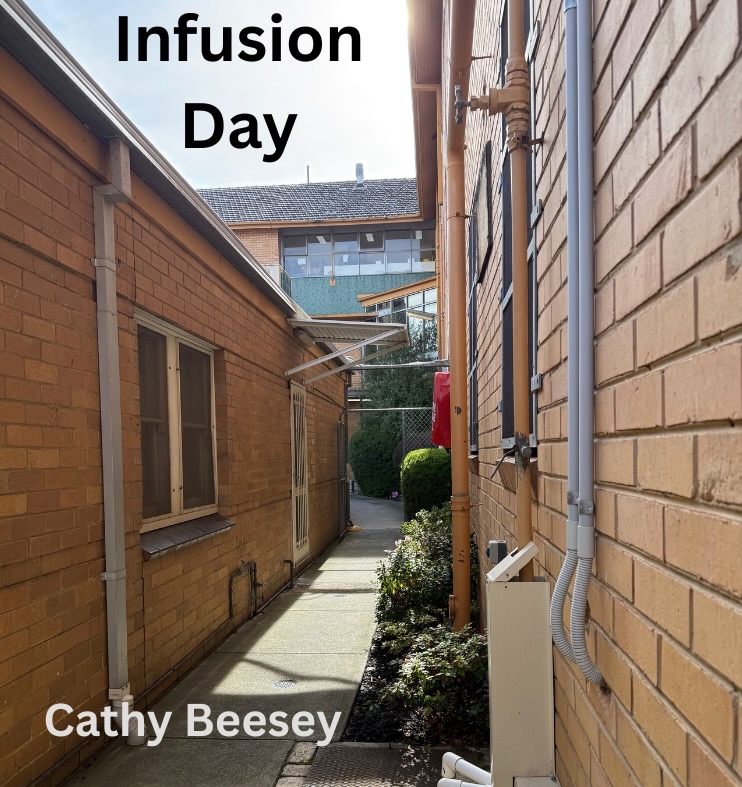
A narrow walkway with cream brick buildings on either side, three steps or a ramp, and at a certain point the large glass door opens. A corridor with walls painted in that hospital beige colour, a door to the large infusion room and another to the left for reception. Paper work is checked, payment organised, and directed to a red hospital chair in the middle of the infusion room. Nurses move seamlessly from one thing to another setting up for the day ahead.
Low level anxiety is heightened to high level. This is the moment the patient wants to walk away. Instead they stated their name, date of birth, and allergies for the first of many times throughout the day.
A large comfortable chair with padding and wide arms, for a hand to be placed for the intravenous line to be inserted. A station established for each of the seven padded chairs situated along hospital beige colour walls and a room for procedures where total privacy is required. The only view outside is from one of three large rectangular windows with only one layer of beige curtain where a silhouette of a single tree can be viewed. Mostly procedures are for cancer but not all, an occasional infusion for an iron deficiency, or an autoimmune disorder.
Infusion today will control an overactive immune system, the patient does not want another relapse with stronger drugs to control: steroids, chemotherapy.
Day Infusion Centre staff are dressed in bright scrubs with many and varied designs. They move seamlessly from one task to another and one person to another. The hierarchy is clear with one nurse informed on all that transpires with each patient and referred to for major decisions. There are some nurses who listen and do as they are told and others who listen to the patient and place their care first.
The patient explains, although it is in the records of previous visits to the hospital and Infusion Centre, ‘The last two times there has been a reaction to the drug and the Medical Emergency Team were called.’ The one in charge states, ‘Follow usual procedure. It will be okay.’ The nurse responds to the patient, ‘I will begin the procedure at the lowest rate. I will show the manager your file and I will keep you safe.’
An antihistamine is given. The intravenous line is inserted on the top of the hand with two experienced nurses working in tandem. It doesn’t work the first time because the veins are supposedly crooked, success the second.
The patient asks, ‘Why is it put in my hand and not my arm?’ A response of, ‘It works better in this spot than the arm,’ the why is not explained. The patient cannot find the energy to follow up.
Saline solution begins to flow. It reaches the hand with a sting of cold, the cold moving through the vein. As the saline solution ends, the bag with a steroid solution begins to flow. This is to reduce a reaction to the drug. Two nurses work together as one holds the bag containing the drug so potent it can be described as a poison. Checking yet again the patient’s name, date of birth and allergies and that it is the right drug. The drug solution attached begins its journey along the intravenous line at the slowest rate. A cup of tea or coffee is offered to compliment the glass of water.
It has now been an hour since the patient arrived. For the first time the patient is truly aware of their surroundings.
The Infusion Centre is filled with activity. Patients come for a blood test and are advised to visit their specialist and return for the procedure, if that is what is decided. Other patients arrive and are known by staff. Some with a short procedure with another one the next and following days or weeks. Nursing staff constantly remind patients to let them know if there is anything, absolutely anything.
A sense of sadness descends over the patient. So many lives impacted by cancer and notices the stoicism of other patients and wonder how they themselves are viewed, sitting in their large comfortable chair.
The second bag of the drug, with nurses clarifying the name and details of the patient and the drug is in place. The rate is increased.
The patient begins to believe that today will be okay, no serious reaction to the drug. And then an itchy throat and ears overwhelm, ‘Nurse I am having a reaction.’
Three nurses arrive and with no obvious communication they stop the infusion. Two nurses do not leave the patient’s side, the other nurse watches from a metre away. The loud speaker throughout the hospital with a calm, measured tone states, ‘MET Day Infusion Centre bed five.’ Nurses ask the patient to describe the symptoms of the reaction and if it is easing, the same, or worse. The patient is asked this over and over. Blood pressure is continually taken. A large trolley is brought to the station with emergency equipment.
This is the second time this patient has been in this situation within six months. The first time the patient heard the message over the loud speaker and thought, ‘This isn’t for me.’ This time the patient knows it is.
One specialist arrives and states, ‘I was nearby,’ and asks questions about symptoms and blood pressure. The patient and nurses respond with details. Another specialist arrives and states, ‘I am an oncologist.’ More questions are asked. No urgency in voices or actions. The patient’s file is read, the autoimmune disorder is clarified. Questions are asked of the patient about their history. The patient’s ongoing specialist is phoned. It is confirmed for the patient by the oncologist that this is the best approach for this condition, even with this type of reaction. It is suggested the patient receive more steroids through the intravenous line and continue the infusion.
The patient agrees and once again realises that these moments are so intense it is as though the world exists only in this station.
It is now the three hour point of the infusion and there is no further reaction, although nursing staff constantly check in.
One hand is unable to move as a hand moves. It is now a sense of frustration and boredom for the patient. No typing onto a computer with two hands, difficulty going to the toilet.
It is the time of the day when no new patients arrive. It is quiet. Nurses move seamlessly from one thing to another to do what has to be done at the end of the day. Staff begin to finish their shift.
Six hours later, with unsteady movements the patient leaves to return in six months.
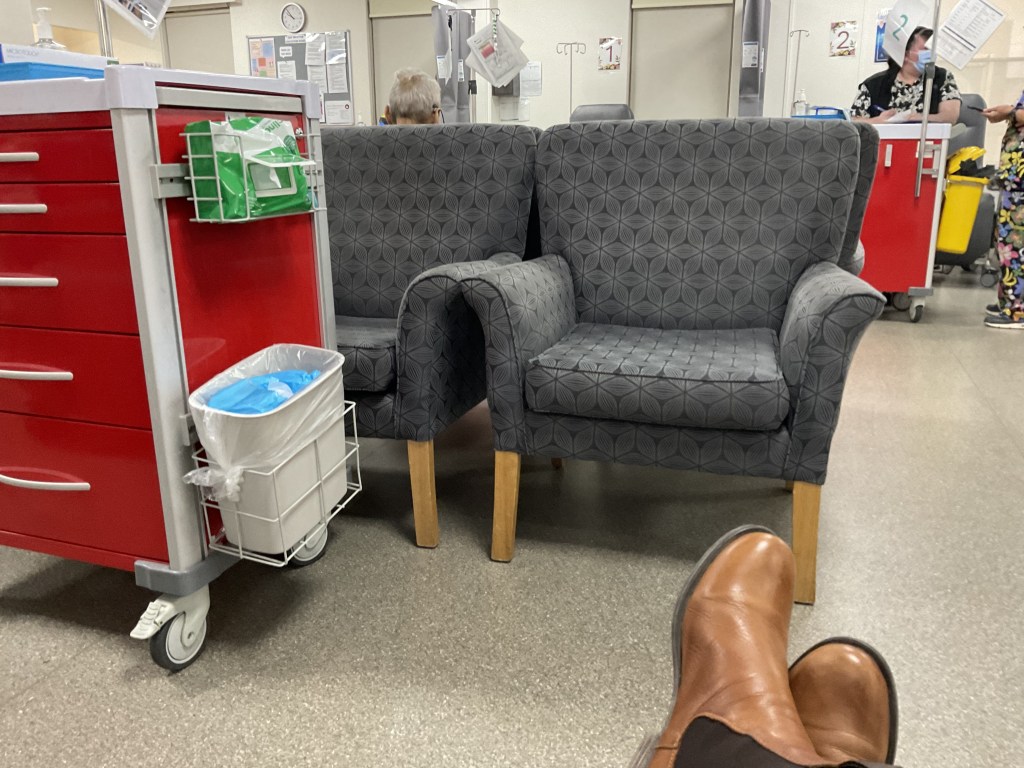
Infusion Centre July 2026
Copyright Cathy Beesey, September 2026. All rights reserved; this intellectual property belongs solely to Cathy Beesey.


Leave a Comment