Learning to live with an autoimmune disorder – A mosaic of my journal
Cathy Beesey Founder Stories Connecting Us
Part 4: Choosing Families
Chapter 14: The Family I Didn’t Choose
The link to my memoir Contents and published chapters is at the end of this post.
Memories of my biological family came to life in my journal as I wrote of my childhood, stories told by my mother and how in our family I and others coped with illness. These memories are of times long before Wegener Anca Vasculitis.
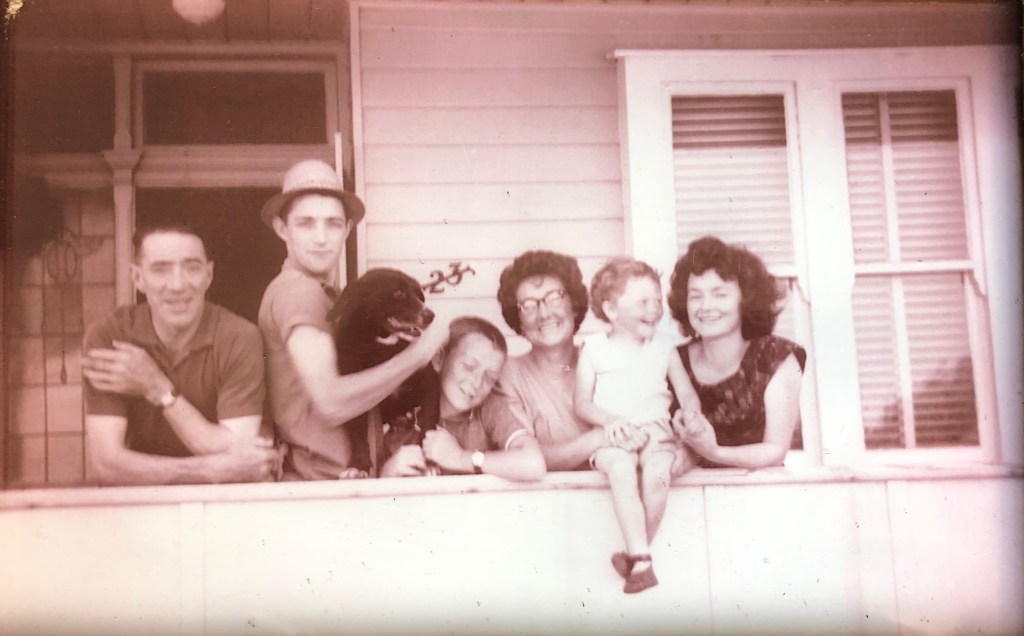
William (Dad), Billy, Sox, Henry, Doris (Mum), Cathy and Gloria, Brunswick 1961
The story of my birth, told by my family, was our mother realising I was to be born walked along Fifth Avenue Brunswick to Sacred Heart Maternity and there it happened. I loved this story asking my mother to tell it over and over. I discover in my early twenties I was born in Footscray Hospital. My mother and father visiting friends, she had been through many miscarriages, and at the first sign of my birth was rushed to a nearby hospital, later transferred to Sacred Heart Maternity (now known as John Fawkner Hospital). When I said, ‘You told me …,’ my mother smiled. My family didn’t let the truth get in the way of a good story.
Born 27 August 1957 to Doris Catherine Beesey nee Phillips (known to everyone as Beauts) and William Henry Beesey (Bill), my mother was 39 and father 46. I imagine my father gently pushing my new pram, proud; my mother walking beside him, exhausted. We arrive to the home where our family will live for the first five years of my life. I will be met by my sister Gloria nineteen, brothers Billy sixteen and Henry nine. My memories of our California Bungalow are large rooms with linoleum on the floor, cool as I play, the smell of daphne, growing outside the lounge window. Other memories, confused with many photos of that time: playing in my cubby, my small armchair matching our lounge suite, swimming in our canvas pool to keep cool, and Christmas.
A photo taken by Peter Fox at 243 Collins Street Melbourne, a fashion photographer from the sixties, is displayed on a wall in my home. It isn’t a photo I love; it acknowledges my modelling career when I was four. Short and something I’ve been embarrassed to share I keep my modelling trophies hidden. I don’t go to kindergarten as my parents are building a new home and we will move during the year before I start school. My mother is concerned I don’t have young children to socialise with and I am clingy, not wanting her out of sight, enrols me in a modelling class at Bambi Smith College. We travel on the tram and walk to 120 Collins Street Melbourne on Saturday mornings. Memories, mostly through photos are wearing beautiful clothes with my very favourite dress, white with large dark green Saguaro cactus (tree like with a trunk and three branches) growing from the hem of the full skirt, sleeveless, tight waist with a bow at the back. Is this where I begin my love of dressing up, of ninety-sixties clothes, pointy toe sling-back shoes and wearing a frock?
My mother loved to tell the story of the time I modelled at Melbourne Town Hall wearing a white quilted dressing gown dotted with small blue bunnies, white slippers with pom poms and shorty pyjamas. And as the story goes, waiting to walk the catwalk I cannot move. Someone quickly hands my much-loved pink teddy bear and as I walk there are sighs of delight and smiles from the audience. Congratulations as I return to the safety of the dressing room behind deep red velvet curtains. Is this where I first gain confidence in front of large audiences and know how to engage them?
*
My family moved to Strathmore North when I was five, a new suburb of mostly cream brick homes. This is the first home my parents have owned never being able to save a deposit until this later stage in their lives. From the age of around five I suffered with asthma missing six months of my first year at school and catching every illness children of my generation did: measles, chickens pox and mumps. Memories: being in my darkened bedroom surrounded by shadows, too unwell to do anything. Joyful memories: playing at home, lying on my raised bed receiving physiotherapy from my mother morning and night, my father reading to me once and my brothers standing in the doorway to my bedroom when I was too unwell to get up.
Play kept me busy, my mother let me do what I wanted to fill my days and be active. Everything would be packed away before dinner, our home returning to a place of order. My pink teddy bear now beige was always with me. I would rub her nose for comfort and to help sleep. The nose wore away with my mother sewing it up again and again, and I would rub it until it was soft. A gift from my brother Billy when I was one and I still have her.
Another memory: in The Royal Children’s Hospital for seven nights with a pin prick on my thumb each morning to test my blood. I dreaded the nurse walking through the door with a silver kidney shaped bowl. One morning a nurse chastised, ‘You have been so brave, you need to do this.’ In hospital I spent long hours alone with my father working and mother taking public transport to see me, with my sister and brothers not allowed to visit. I saw my brothers once on a Sunday morning as they stood in the park below, as I stood at the window on the seventh floor.
At home I remember my mother rushing into my bedroom during the night as I struggled to breathe. In my teenage years she explained how she would lie in her bed waiting. The medication was limited and all she could do was sit quietly in the dark by my side. The doctor thought my asthma may be caused by the new carpet in my parents’ first home. They considered removing it but decided it may not make a difference. And during this time my father smoked in our home. At night he would sit in his armchair with his 1960s ashtray by his side.
Miraculously I grew out of my asthma when I was seven, this is what the doctor told my parents. And my life and my mother’s life changed forever, for her relief. Is this when I learnt the success of being healthy and making everyone happy? For the rest of my life, until now, this is what I have done. I have gotten well quickly and easily, and I have rewarded myself for this and been expected to do so by others.
*
My parents want for me as they wanted for each of their children, a more prosperous life. We live in a new suburb with many young families, I am uncomfortable with parents so old. My best friend’s mother always looked perfect with make-up and lovely clothes, and we look nothing like the families I see on television. I notice my mother is happy when working around the house and gardening, not worried about what she is wearing. She changes to go to the shops, dresses well when she goes out and makes an extra effort for a special occasion. Her mother died when she was seven, she never learnt about skin care and those things a child watches a mother do. My mother did learn from her father the importance of quality clothes and to always have clean shoes. I love to dress well, admiring those that always look perfect: smudged eyeliner, lipstick forgotten to be re-applied, that’s me.
My mother ran our home and us children. My father worked hard and let her do this for him. When he was young his family were poor, and many times could not afford to pay the rent leaving one home for another usually in the middle of the night. His father died when he was fourteen and my father had to work giving up a scholarship to study. These stories I learnt from my mother. My father was much younger than his siblings and it wasn’t until after his death we found out why. The woman he thought was his sister was his mother, the woman we called Aunty Anne was our grandmother.
*
I have complained about my mother and blamed her for many things. She was a strong woman frustrated by her life with a fierce intellect that in different times would have given her more options. My mother and I would sit on a Saturday or Sunday afternoon as she baked or ironed every piece of clothing: tea towels, sheets and underwear; debating anything and everything. For my mother it was about winning, I was never allowed to. I cannot remember the topics we disagreed on, but I do remember the feeling of not being heard.
My mother instilled in me how to see people for who they are not the group they belong to. As we talked, she often said, ‘There is good in everyone.’ ‘See each person you meet beyond the label society gives.’ ‘The most important thing is to treat people how you would want them to treat you.’ My father was on a pedestal possibly because he was kind, quiet, gentle, and annoyingly funny with his dad jokes. My dad growled at me once, yes only once and I cried, he never did it again.
My childhood wasn’t perfect, but I was fortunate to be born into a family where caring for your children and wanting better for them was what my parents did. As a young adult and throughout my life I have felt a vulnerability, at times abandoned with a sense that what happened in my life wasn’t important. I strived to achieve at everything I did, and I have achieved much but it’s never been quite enough. My parents never showed their pride of who I was and what I did during my time at school, career and what I did for them. They never told me, but they did tell others. This is how I slowly found out they were proud, so very proud.
*
I bought my own home in Brunswick East on 1 November 1985. I was twenty-eight, drawn to Brunswick and California Bungalow style homes. I didn’t expect to live here for long but here I sit today writing. In my twenties, thirties, forties, and fifties I am surrounded with illness and despair as my mother is lost to us through dementia, my father battles cancer, is operated on for an aneurysm and has a stroke and later my sister will be diagnosed with early on-set dementia. I fear I may be next. My brother Bill and niece Cassie have heart attacks, and my brother Henry is diagnosed with a melanoma. He returns from his home in Vietnam and lives with me during this time. In-laws: my brother Billy’s wife Allison lives with multiple sclerosis and my sister’s husband George died suddenly of a heart attack.
Some of the family crisis stuff fell to me or I took the responsibility from others, the youngest by far, educated, and confident to find out what we needed to know. My siblings will have their own stories. My parents were so sick for so long we moved seamlessly into our roles: who will visit first. Gloria took over payments and other details, Billy visited often and Henry in Vietnam or some other part of the world came home for stints when there was a crisis. I managed communication with doctors, and I fought the battles. I chased the doctor along the corridor to find out what was wrong with my father, cancer in one of his kidneys.
Alone, I took my mother to the aged care facility. It made sense at the time because I was her favourite. There was always a favourite, always someone she didn’t like, and it changed regularly. I felt both loved and disliked. First attempt: I take her to the aged care facility and bring her home, I cannot leave her. For the second attempt a social worker provided a list of steps to follow, again I bring my mother home. Trying to talk to the social worker she stated, ‘You mustn’t have followed the steps properly.’ On the third occasion I leave my mother. She pretended to have a heart attack, was taken to The Royal Melbourne Hospital, and returned to her own home. I phoned to get her into a long-term placement in an aged care facility and was told, ‘Your mother wasn’t successful, and she only has one go at it. She missed out last Monday.’ I get her in.
With each family illness I feel despair and chaos, believing I must be strong. When the despair overwhelms, I get angry and upset about something else and lash out. Quickly and without a thought someone says, ‘Pull yourself together,’ and when I can’t I am told to leave. My vulnerability stays within. During this time the only way I feel heard is to argue. Beginning with trying to explain, ending in yelling.
Through all this my sister Gloria and I acknowledge what each other does and are kind knowing the other is hurting. Gloria teaches me you ultimately must work through the hard stuff alone. She explains one night as we stand outside her home in the warmth and dark that even though George is a good husband he couldn’t be there for her when it came to dealing with our mother and her dementia. He thought she should just get over it. Softly, gently, ‘Having a husband won’t help you deal with this. There is no getting over this.’
Gloria managed Mum and Dad’s finances and when it was our dad’s birthday, after his death, we would go shopping and buy ourselves a gift knowing Dad would like this. We laughed about our secret gifts and that our brothers were not part of this. We laughed often and I always loved and admired Gloria for her sweetness and kindness, she never judged.
*
I lose my sister as I lost my mother, to dementia, this time early onset. It was twelve months after George her husband had died when she was officially diagnosed. Before his death I had noticed changes in her behaviour. And how did it happen I spoke to her first? I was asked by Gloria’s children, and I wanted and needed to do this, to fix it as best I could; knowing I had the strength to have this hard conversation. Some of this I learnt from my mother but I’m not sure where I got the ability to talk so honestly and openly about the hard stuff. Maybe some from my brother Henry.
Gloria and I have dinner sitting at the round table in the kitchen area of her home. We talk of different things then gently, ‘You seem to be getting forgetful and confused easily. Maybe it would be a good idea to have some tests.’ I rehearsed these words so many times I remember them clearly. I tell her of a colleague who explained for the first year after her father died, they thought her mother had dementia, but it was shock and depression. Overwhelmed with sadness I see this reflected in Gloria’s distant, hazel eyes, neither of us cry. We have been through this together with our mother, surely, we won’t have to go through this again in a different and for both a more painful way.
As we sat at the clinic, Gloria, her children and I, with four specialists it is confirmed. One specialist looked at me and me only, ‘If your mother had late onset and your sister early onset the chances of you getting dementia are statistically slim.’ I acknowledge this specialist for noticing my fear. I hold onto his words. As dementia takes more and more control, Gloria fearful and confused shows her kindness always; she was grateful and thanked me for every little thing I did. I never see her angry, disagreeable side. I find it hard to visit her as dementia takes over and she no longer knows who I am, losing her the way I lost my mother. My visits when she is placed in aged care are irregular.
*
And me, I have the occasional illness that is always diagnosed and can be treated easily and quickly. My asthma returns in my late twenties managed by medication; diagnosed with pernicious anaemia: my body cannot absorb B12, managed through B12 injections; diagnosed with diverticulitis, a bowel condition that I learn to manage with my GP; and essential tremor, hands shaking, genetically from my father, managed with tricks and techniques.
Like my father my health conditions become more of a story to tell than something I live with. In my late twenties and into my thirties each November I become ill with the flu, more like exhaustion, falling in a heap and taking two weeks to recover. I never truly saw or felt this coming. Once I am so sick I returned to my parents’ home. The slightest bit better my mother said, ‘It’s time for you to go to your own home.’ I could never be sick for too long with my mother.
Copyright Cathy Beesey, May 2025. All rights reserved; this intellectual property belongs solely to Cathy Beesey.
This is the link to my memoir Contents and published chapters.


 Stories Connecting Us
Leave a Reply to Cathy Beesey Cancel reply