Learning to live with an autoimmune disorder – A mosaic of my journal
Cathy Beesey Founder Stories Connecting Us
Part 3: On A Treadmill
Chapter 13: Do I have a Disability?
The link to my memoir Contents and published chapters is at the end of this post.
The Disability Discrimination Act 1992 defines ‘disability’ as: total or partial loss of the person’s bodily or mental functions; or. total or partial loss of a part of the body; or. the presence in the body of organisms causing disease or illness; or. Australian Government
To be eligible for a Disability Support Pension, you must be assessed as having an impairment rating of at least 20 points from any of the tables. If you are assessed as having an impairment rating of less than 20 points, your claim will be rejected. Services Australia, Centrelink March 2019
This information on disability is what I find as I search the internet. It is too complex with Commonwealth and State Legislation and Acts to search further. I do wonder if this is the most current definition of disability. 1992, nearly three decades ago. Anguishing, wondering … do I have a disability? YES, according to the Disability Discrimination Act 1992. NO, according to Services Australia, Centrelink. YES, Local Council. And me, I do not know.
Another day, another challenge, a different treadmill, one I don’t want to be on. I won’t receive an aged pension until I am sixty-seven, in six years. So far into the future, with a life I cannot imagine, my dreams of working in paid employment and volunteering stand still. Now for the hard conversation about Simon Russo our financial planner supporting us with Centrelink, Healthcare Card and what types of support payments are available. I cannot do it. I hate all of this at the best of times: completing forms, sitting in a Centrelink office with a stranger and going through details is all too much, breathing constricts. Stan wants to do this for me, I think he believes I think he can’t do it. I know he can, but I can’t let him, and I know when, what and how to delegate. First week home I write to our financial planner.
Morning Simon,
Things have changed dramatically for me in the last few weeks. I have been diagnosed with an overactive immune system condition called: Wegener Anca Vasculitis. Difficult to diagnose, can be treated with an extensive drug treatment organised around three months, six months, 2 years, rest of my life.
So, Stan and I are wondering if you could help us work out the best way to go with Centrelink. And to take the lead for us; letting us know any fees. The Cathy Travelling business is on hold. The cost of drugs is extensive and there won’t be an opportunity for me to generate any kind of income. My GP can provide all supporting documents when he knows what is required.
I could never have imagined I would be writing this type of email to you. I look forward to hearing from you. Text and phone are the best way to contact at the moment.
Thank you
Cathy and Stan
Daily Caption: Generosity from Simon our financial planner, Thursday 7 March. Meeting with Simon is as I expected: compassion and down to business. I share with Simon the most relevant health issues and how grateful and privileged I feel. We talk of those less fortunate dealing with something like ‘this’ without a beautiful home, family, friends, no money, not speaking English as a first language and the challenges of working with Centrelink. A view they have a disdain for people applying for the Disability Support Pension or any type of support, anything slightly complex is most often placed on the too hard pile, and the time it takes to process applications. Where is the compassion? Where are the structures and support when life takes a turn, and you don’t know where to begin? Are there other types of support for people in my situation? Simon explains how difficult it is to get the Disability Support Pension with legislation that the condition will be for a minimum of two years. Simon will find and send through forms for my GP to complete.
Simon leaves, the reality of applying for the Disability Support Pension hits, hurting my heart and sense of who I am, impacting on my dreams. My dream to write a book and be published stopped. Trembling, crying, I knew we would have the conversation about the Disability Support Pension, but I couldn’t have ever imagined I would ever be applying. Could Stan have imagined this on Christmas Day? I ask Stan to stay with me for a while, he sits on the end of the couch, his hand on my shoulder. It helps, I hope it helps him.
I feel entitled. I have never complained and felt proud paying taxes, a significant amount, contributing to society. I have given and now it is my turn, not that I wanted one. Another harsh reality, I must find a new way of being okay. If I do go onto a Disability Support Pension will this define me?
*
Stan will try to lodge an intent for the Disability Support Pension today. If there are any payments, they will begin from this date. The phone system with Centrelink is not working. How do people do this? Stan decides to go to Centrelink, for him it is easier, more effective doing things in person. He is early, taken straight through to be told, ‘Lodging claims stopped eighteen months ago. The Centrelink form can be uploaded without the doctor’s report. That is the date payment may begin.’
My day full of doing different things, physically moving more. I do the physical tasks I can while Stan does the out of home things: shopping, visits to our accountant and Centrelink. Next visit to Centrelink Stan waits at the office and an hour later the Disability Support Pension form is uploaded. It is Friday 29 March, it is done, I have applied.
*
I share with my lifelong friend Marg, ‘Very occasionally, in the past, I thought if I got cancer on my face or some other physical disability I could not cope and would be too embarrassed to leave my home.’ How I contradict myself with my face rounded and fat. It is weird what I thought and now this has happened it doesn’t matter at all.
Buying a gift for my friend Marg I cannot stand while Stan pays. Finding a seat I watch older people struggle to walk as they are out shopping alone. Driving home a woman walks tentatively across the road, ‘She is so brave. How does she find the confidence? I am not confident to go out alone, yet.’ Stan responds, ‘Maybe this happened to her over time, and it was slow.’ I wonder when I will go out alone.
Late afternoon as I close the blinds of the dining room window, I watch a man walk carefully along the street. I now notice people moving like him, taking each step tentatively, as I now do.
*
Waiting to see my GP Dr Nico Rossi, a woman stares. I wonder what she is thinking. I sense compassion, how could I know? Am I that obvious in showing my illness? It has always been hard to imagine what I look like to others, now I have no idea. Do I look like I have a physical disability? Do the steroids make me look well? Do I look younger because I have no wrinkles? Do I look strong, fearful, sad? Possibly some or none of these things to her. I am all of these to me.
Dr Nico Rossi’s medical report documents the symptoms of this autoimmune disorder and side effects of the drugs I take daily. I wince at some of the words: severe lethargy, Oesophageal influx, Hyponatraemia (low concentration of sodium in the blood), Anaemia. Nico describes the impact of the treatment on my balance and how this impacts my movement, to a degree that I would be unable to work, leave my home alone. I have described it as a heaviness, realising it is also balance.
Another layer of understanding to deal with. I am not angry, I’m exhausted living with Wegener Anca Vasculitis. I use my strength to keep as healthy and positive as I can, but I cannot pretend this is not serious. In the report Dr Nico Rossi provides detail of the induction treatment that will continue for six months, remission may or may not happen and I will live with this autoimmune disorder for the rest of my life. Now understanding more the difficult journey I have been on, am on, will be on. The medical report is to be uploaded for Centrelink.
At home I try to read the report but cannot with my hands shaking, vision blurred: symptoms, side-effects, anxiety and fear. I know I must face this detail again asking Stan to read it, wanting to gauge what he is thinking as I watch him read sections of the report for the first time to himself and then out loud.
*
Do I have a disability? You don’t apply for a Disability Support Pension if you don’t. I could never have thought, imagined this would be what I was doing. I think of the many others who have learnt to do things in different ways, living different lives, adapting and those living with a disability from birth finding their way through a world not designed for them. And for those living with a disability, as I now describe myself, each has their own story and will take their personal journey with family and friends. I am finding my way: learning each day what I can do, what I struggle with, how to adapt and how to find those moments of joy. I am not wanting to speak on behalf of others as I cannot. I have no more words.
My horror, anger, dismay at the words of a well know sport reporter making a comment about a woman and how badly she tossed the coin at the beginning of an AFL football game. He had not bothered to find out her story of living with Cerebral Palsy. Then of course he apologised while others made excuses for him: he really is a good person, he didn’t realise what he was saying, he has apologised, he has raised this issue in the broader community. I cannot believe these things are said of him. He has demonstrated on many occasions in many contexts that his behaviour is not acceptable but still he continues to be paid huge amounts of money, is given time by the media and for those that care we know he will do it again, as will others.
*
24 May: I need to take control of the process for the Disability Support Pension as nothing is happening, the treadmill on pause. I don’t know where to begin. I don’t want to be on the phone waiting for most likely more than an hour to find out what’s happening with my application.
4 June: A text from Centrelink for an assessment interview on 2 July. Time to research: finding out about disability advocacy groups, a support group for Wegener Anca Vasculitis, to give it my best go. A focus for later this week or next but not today. I know in my heart this is something to fight for. I am entitled to be supported as I cannot work, although the prognosis is good, looking promising, I do not know. It will be close to five months since diagnosis when this interview will be held.
I phone the Disability Resource Centre Advocacy for advice on my meeting with Centrelink. This Centre is an individual advocacy and campaign organisation that works to ensure Victorians with disabilities enjoy the same rights and opportunities as every other member of the society. Nick explains, ‘It is most likely about your capacity to work,’ focussing my thinking and notes in preparation. I write eight hundred and ninety-one words using the headings: inability to work, about Wegener Anca Vasculitis, possibilities, work history.
I again refer to Dr Nico Rossi’s report saying to Stan, ‘Maybe I will need a wheelchair in the future.’ I do want a wheelchair to go out more often: shopping and other places where I can’t walk the long distances and there aren’t places to sit and rest. I hadn’t realised how far you walk when out, now knowing the impact this has on my easily fatigued body. Stan’s friend Steve has offered the wheelchair he bought for his father, his father has died. It is only now Stan tells me this.
*
Cheryl, my friend, is trying to find the words to ask, ‘Are you too proud to get a disability parking permit?’ ‘No, I hadn’t thought of it. The next time I go to the doctor I will ask.’ I share the story of the Disability Support Pension treadmill I am on and how I continue to wait for a response. Cheryl holds a mirror to the person before diagnosis and now after. My sense of pride has changed. I am proud of different things: my discipline and determination, and showing kindness rather than the superficial examples I previously used to describe pride. I now don’t think having a disability parking permit has anything to do with pride. It’s about how I now live my life. I share with Cheryl we are going to the National Gallery of Victoria to view the Alexander Calder Exhibition, explaining I will need a wheelchair with, ‘Better to see the exhibition than not. I’ll be okay using a wheelchair.’ This will be a new way for Stan and I to venture into the world. It will be after Easter and Anzac Day, finding a quieter time to visit.
Daily Caption: Alexander Calder Exhibition, National Gallery Victoria and I view it from a wheelchair, Tuesday 11 June. Stan wanders off to take photos, I am stranded. I use my feet to move the wheelchair. This isn’t right, I explore: taking hold of the wheels I move the chair ever so slightly, it still doesn’t feel right, dangerous, and then I find the frame above the wheels. Beginning to move, delighting in working out how to turn, how to put more emphasis on one side compared to the other; to move forward and backward now knowing I can move through the exhibition at my own pace. I am always looking up, my neck further back than I am used to, and it is especially difficult to see the jewellery from the height I sit rather than looking down on each of the exquisite pieces displayed. For this I stand.
*
Monday night 1 July I am overwhelmed with thoughts of my meeting at Centrelink tomorrow. I have prepared all I can thinking it will be about my capacity to work but I don’t truly know. Give me the serenity to know the things I cannot change. Tuesday 2 July I am ready early, making sure I had things organised last night. It is with anxiety, feeling tentative that we go to this interview. Stan’s cold has got worse, and he is more anxious than me, it seems.
The only contact I had from Centrelink was a text stating the date, 2 July and time, 10.00am and it was quite a while ago. On arrival I give my details, worrying I had to confirm, do something but this isn’t the case. Waiting around ten minutes, then directed into a meeting room with the Centrelink representative, she is a trained psychologist. She outlines what we will talk about, saying, ‘It may be hard for you to go through this again.’ It is as I expected: details of when I first got sick and the process of being diagnosed. This is easy, telling this part of my story confidently and clearly. I am asked about my physical capacity and career. It is interesting I am never asked if I think I can work. Is this presumed because I have applied? I explain I am seeing a psychologist regularly, beginning shortly after diagnosis.
She states, ‘Your specialist should have completed the medical report.’ ‘I thought that was the next step.’ ‘Your doctor has been arrogant in writing it.’ ‘He is not arrogant and thought he should do it.’ Her response, ‘Well not arrogant, more not appropriate.’ She explains, ‘If I had read this report, I wouldn’t have let it move to the interview stage.’ I am shocked, hoping this doesn’t influence her decision. Toward the end of the interview, I talk of having a privileged life, bringing tears. Stan explains, ‘Not being able to see people with colds, to go out and we haven’t seen our granddaughter, Jade. She has Cystic Fibrosis.’ Stan cries, the tissue box that was moved toward me is now moved toward him.
Next steps: She will meet with a colleague with expertise in physical disability and write a report stating eligibility and if yes there would be a medical examination with a doctor to confirm. If I am not eligible, I can appeal. When the report is written it will include that I could receive benefits through New Start (unemployment payments) without having to go through the process of looking for work. This would be for eighteen months. We leave, I am drained, and not confident I will be successful. I will appeal and go to my local member if not. Stan agrees that I won’t be successful and that many people would be satisfied with being on New Start without having to apply for jobs. I am not. I will appeal.
For Centrelink a health condition must be long term (more than two years) before you can receive the Disability Support Pension. Why? I now understand one of the issues identified in the Victorian Royal Commission into Mental Health, having to have had the mental health condition for an extended period, more than two years, before support can be provided. Do they not know the importance of early intervention?
My plight feels diminished after my meeting at Centrelink. How must others feel, especially those grappling with a mental illness, mine is physical and I use my intellect and knowledge to make sense of the feelings I have, as best I can. How do others cope? Can the Victorian Royal Commission have an impact on the Federal Government, Centrelink? I am not sure. I don’t know how this system works. I also wonder is this the best use of my time, to find out things where I cannot have an impact.
Arriving home from my appointment, in the letterbox is the Disability Parking Permit. Wow, I must really have a disability. This is as I look at my newly acquired wheelchair under the carport. Yesterday I returned to the definition of disability in the 1992 legislation. Stopping after the first section as I felt myself being drawn downward into a state of despair. This condition, the treatment, has led to this day with: confusion, sadness, strength, courage, mostly gratitude.
Could I have imagined I would be applying for a Disability Support Pension and have a Disability Parking Permit? Never. Could I have imagined I would be excited to have a wheelchair? Never. I choose to face life fully and with strength, I surprise myself.
*
22 July, over five months since diagnosis: writing, reading, ABC News Breakfast, checking emails. I have received correspondence in my MyGov account. It will be about the success or not of my application for the Disability Support Pension. I eat breakfast and take tablets, my greatest priority, and being ridiculously optimistic I think I may be successful. I am not and not sure how I feel. Dismay: I am not considered by the Federal Government and Centrelink to have a disability but mostly frustration: I haven’t been able to work, and I cannot work now. My option is to contact Centrelink to find out what other support can be provided; I don’t seem to fit into any categories. There are gaps in our system. I will deal with this tomorrow.
*
Doctor, specialists and psychologist appointments, tests and treatment, my life on a treadmill. Before this I could run on a treadmill, sometimes this treadmill I am on moves ever so slowly and others it is on pause. I am grateful to be on the treadmill I am on. And I am not alone, travelling on this journey with Stan, family, friends and memories of my childhood.
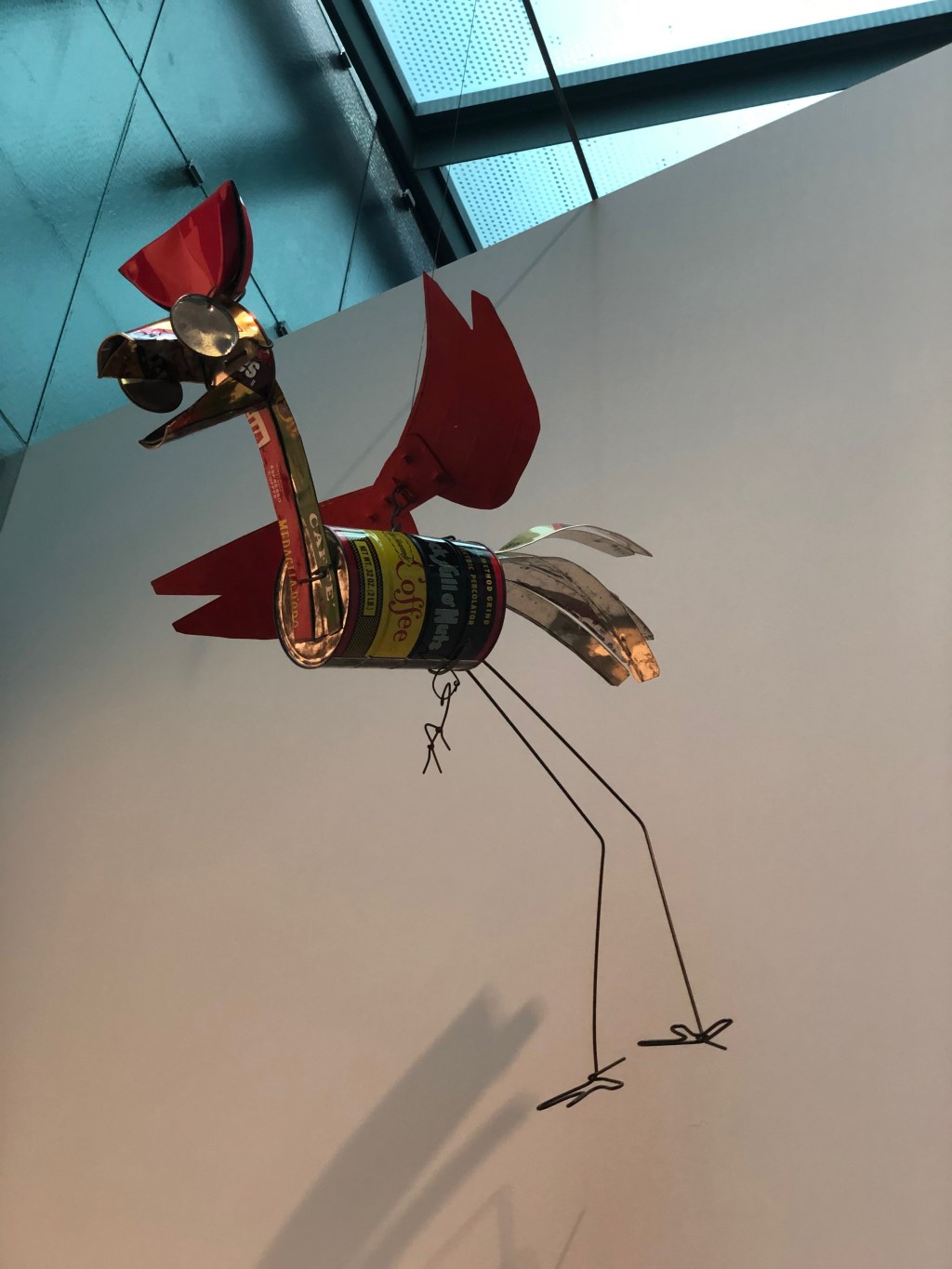
Alexander Calder Exhibition National Gallery of Victoria 2019
Copyright Cathy Beesey, May 2025. All rights reserved; this intellectual property belongs solely to Cathy Beesey.
This is the link to my memoir Contents and published chapters.
 Stories Connecting Us
Leave a Comment