Carmel Alakus
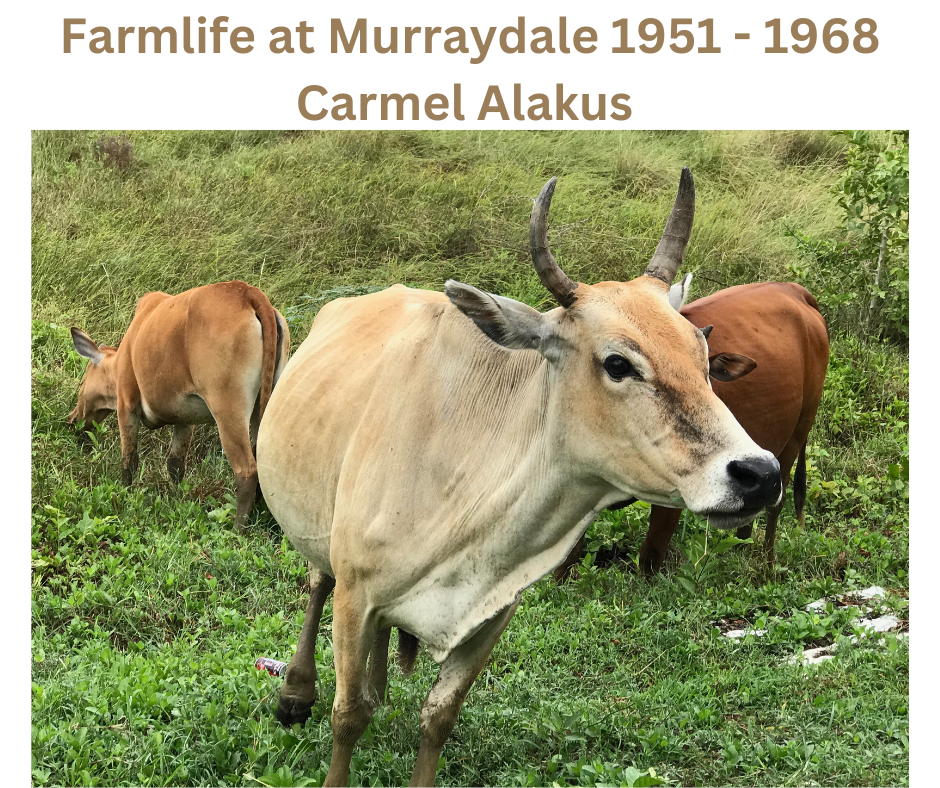
The Cows
Days at Murraydale started early for my parents who were dairy farmers. The alarm sounded at 5.30am. Dad made a thermos of tea. Mum donned her rubber boots and walked with the dog to whatever paddock the cows had grazed in the night before. In midsummer dawn pushed back the night sky so the animals could be rounded up in daylight. Closer to winter it was still dark. Some cows had to be woken up and woken again when they arrived at the dairy.
Each cow had a name. Big Mopsy, a red pole was the undisputed leader. Any other cow who forgot that was head-bunted in the ribs. Mopsy was first to the gate and first in the bale.
My parents loved their animals. Not to make them pets but they showed them care. The lush pastures had only a little clover interspersed with other grasses. Too much clover caused bloat from which cows could die. We also liked to think our cows had the intelligence to stand with front feet on the channel bank if suffering from indigestion.
That stance caused them to burp alleviating any danger. In addition to green pastures, the cows were indulged with a small can of chaff and another of bran in the bale. They loved it. As an occasional treat, my parents plastered a pole in the yard with molasses and coarse salt.
The cows licked and licked the sweet, salty mixture with obvious enjoyment, their hides glossy as a result.
We owned one bull released from his own yard near the cow pen at milking time. Mum would write the date in her ruled exercise book when he served each cow and in another column, 9 months hence when a calf was expected. If he was a slow mover, sometimes a second bull was borrowed to help with the task.
As the winter approached and the cows’ milk lessened in quantity and quality, my parents dried them off to prepare for their holiday. The cows’ holiday that is. My parents only had one holiday away in the years I was growing up. The cows, on the other hand, had a holiday every year. As the pastures on our farm turned dormant, winter grasses such as rye sprang to life on the mallee farms where many of our relatives lived.
My father would borrow a horse and we would drive the cattle 30 kilometres or so to be agisted. Mum drove the car ahead with us kids to block driveways to prevent cows taking a wrong turn. Away from familiar surroundings even Mopsy made mistakes sometimes.
Just before the spring when the calves were due, we drove them back again. Calving was hard. In late August, the weather was usually at its wettest and coldest. Sometimes my parents had to help a cow give birth by pulling a calf out. Vets were busy and expensive. However, there were occasions when they were called for a difficult birth or if a cow was down with milk fever.
In the early days, we separated the milk. The skim milk was piped to the pig sties, where at one point we held up to 100 pigs. A cream truck collected cans of the remaining cream for the butter factory in town. Later that changed so that all farmers big and small sold whole milk. The butter factory closed and we sold our pigs.
I remember it as a satisfying life growing up. However, my mother enjoyed farm life more than my father did. He fretted over money.
Small farmers (blockies) were under constant pressure to get bigger or get out. The community/economy at large was no longer prepared to subsidise dairy farmers and the farming sector generally was under pressure to be more corporate. Never mind that we were expected to compete unfairly with other countries whose governments did subsidise their farmers.
Not taken into consideration either was that a way of life was at stake. Community life was rich and neighbours close. Children attended local schools and played sport for local teams. More of that later.
Farm Chores
Growing up my brothers and I helped with farmwork but I never thought it onerous. Sometimes I helped with the milking. This became more appealing when I discovered one of the cows was tame. A cute little Jersey whom my parents named ‘Savage’ after her former owner; she didn’t pull away when I tried to pat her. Instead she continued chewing her cud contentedly as before.
I renamed her Pattie, after my favourite pop singer, Little Pattie.
When driving the cattle to and from the dairy Pattie hung back. What would happen if I jumped on her back? Nothing untoward as it turned out. Pattie waited for all the other cows to head down the track and then set off with me on her back. Driving instructions were simple; a rap with my knuckles on her back bone meant go; waving my left hand meant turn right and conversely waving my right hand meant turn left.
Another thing I discovered was that the hairy, oily hide of a cow, good for protection against all weathers, left filthy brown marks on my bare legs. A pair of old jodhpurs my mother wore when she was young and discarded at the bottom of a wardrobe, proved just the thing.
I pretended Pattie was a show cow, brushing her coat and polishing her hooves with black nugget till they shone. Pattie accepted my actions in good grace. One day while lying on the grass looking up at her, I learned cows don’t have top teeth, just rough skin on either side of the inside of their mouths. They wrap their tongues around a tuft of grass before searing it off with their sharp bottom teeth.
By working their lower jaws from side to side they mash it, swallow it and regurgitate it from one of their four stomachs when chewing their cud.
While Pattie’s social skills with human beings were exemplary her motherhood skills were deplorable. Every spring after a cursory glance at her newborn calf she walked away. Fortunately, the herd had their own foster care system in operation. Another cow who calved 2 weeks earlier, whose calf had been sold, came bounding across the paddock to lick Patty’s calf clean and claim it as her own. The same scenario was repeated year after year.
Copyright Carmel Alakus January 2025. All rights reserved; this intellectual property belongs solely to Carmel Alakus.
Carmel Alakus
In my writing there’s a tension between the country girl I once was and the tertiary educated, city dweller I am now. My piece Mum caught in a spindle 1953 describes a farm accident when dangerous farm machinery wasn’t routinely covered. People were expected to be on their mettle. Today, in some quarters, safety is still ignored.
I remember wanting to write ever since I was a child. Now retirement allows more time to do just that. In addition, U3A’s Community of Writers provides a supportive forum and has inspired me to write pieces that may one day form a memoir.
My career as a social worker honed a commitment to social justice, seeded during my childhood. Over the years I wrote regular articles in a social work newsletter, occasional articles in social work journals and co-authored chapters in social work textbooks.
Monsieur Montreux with names changed, reflects an experience I had as a young social worker. Practice has changed since then, not always for the better.
Here is Carmel’s other piece. Enjoy .

 Stories Connecting Us
Leave a Comment